
A Digression: When it comes to a potential Jason Robertson Olympic snub, let's focus on a different debate
On the nature of roles.

I didn’t want to write about this. Honestly, even now I don’t feel like it. But I do feel compelled. This is, in the wake of Sean Shapiro’s comment that it’s increasingly looking like Jason Robertson might be snubbed, a hot topic. My completely generic tweet about going Bruce Banner or whatever got thousands of views and hundreds of likes. The What Chaos guys had the tact to title their video ‘Why does Bill Guerin hate Jason Robertson?’ and even the Dallas Stars official Twitter account sent this passive aggressive tweet. A lot of people care about this one.
Because we don’t have official word on whether or not Robertson will make the roster, I’m not getting worked up about it. Will I if it happens? You bet; to my health’s detriment. Although I’ll do my best to enhance my calm when it gets down to the marrow. Until recently, I didn’t really have an angle. After all, why sacrifice my blood pressure if Robertson does, in fact, make the cut anyway?
Well because there’s something instructive about this process to begin with. And it’s something that highlights why teams have so much trouble being on the same page, whether it’s coach vs. GM (as we saw in Montreal), owner vs. GM (as we saw firsthand in Dallas re: the infamous Ken Hitchcock reunion), or even owner vs. coach. And it’s as complex as it is straightforward: players are still assessed for their specific value in proportion to role rather than their broad value in relation to impact.
This is a lot easier to see when there is no cap, and a team is free to simply choose the best of the best. The theoretical dilemma Team USA has is that a top six scorer might not be as affective in a bottom six role. Except this is a race. Which is like saying that you can’t race your SSC Tuatara, which reaches speeds of 282mph, on the highway since you’ve always used it to race on the street. Why can’t your bottom six be allowed to score? In a cap world, that answer is easy. But there is no cap here. So what’s the problem? Wouldn’t it be great if your bottom six could score?
This is what I believe the real core piece of analysis is — how coaches, GMs, and owners frame player evaluation: the broad framing of player impact (i.e. Corsi, WAR, sG, xG, etc) and the narrow framing of player performance (faceoffs, hits, goals, passes, etc). Role versus impact. It’s precisely because these two can contradict one another that we get this tension over who belongs where. It’s why players like Cody Ceci, Ben Chiarot, Travis Hamonic, and Matt Dumba end with careers past their expiration date. It’s why someone like Vladislav Kolyachonok is discarded over someone like Alex Petrovic. Or how Jordan Spence got chased out of L.A. It’s why inexperience tends to be the first sacrifice to the chicken finger gods of the pressbox and such a nonstarter for head coaches; because inexperience is an obstacle to determining one or the other. It’s also why we never ask the question: who’s to say the roster Herb Brooks didn’t choose wouldn’t have also won at Lake Placid?
While I do think there’s something specific to Robertson’s potential snub, it’s also about hockey culture too; specifically North American hockey culture. These decisions aren’t just for Team USA. Why is having Macklin Celebrini on Canada’s roster even up for discussion (he has since been selected)? Or Connor Bedard, for that matter, assuming he’s healthy in time for the Olympics? In what world should we argue over whether or not Matthew Schafer is better than Travis Sanheim or Drew Doughty? Aren’t these the same people who believe in The Eye Test? Or is there fine print there about needing more time to test with the eyes? Maybe it’s a Time Test! Or maybe this entire heuristic makes zero sense and always has.
All of this framing is precisely what makes ‘us’ think Robertson can’t play a bottom six role. Or that he can’t check. Cough.
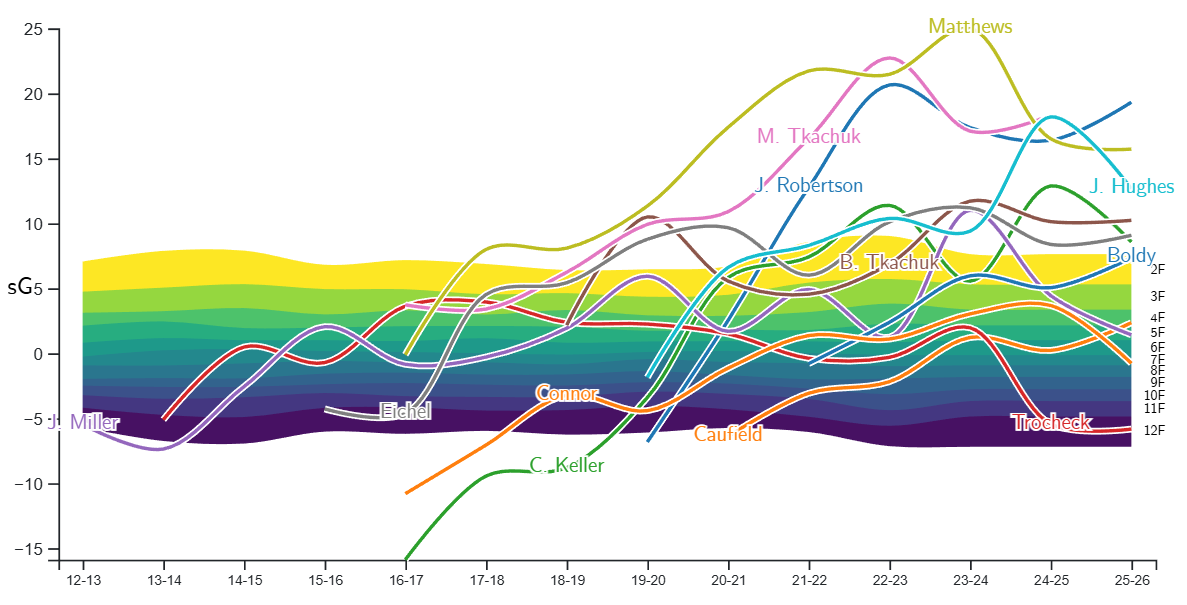
Or that he can’t defend. Because we’re anchored to seeing defense one way, rather than multiple ways. Just as hockey is anchored to seeing roles we’ve always known instead of impact that continues to evolve. I don’t know if Robertson can play in a bottom six matchup role for his Olympic team. I just know he has no equal compared to his countrymen when it comes to on-ice impact. So this is about Robertson. But it’s also about players who Robertson could theoretically be scratched for — the players whose role outweighs their impact. And how that framing trickles down in subtle but vital ways. It’s the discussion we’re always having; whether it’s about a player in the top six, the bottom six, healthy scratched, or a reinforcement from another team. And if you’re not careful, it’ll catch up to you. Just as Team USA will regret not having that extra goal at a critical juncture (kind of like last time), teams in general often regret not icing their optimal roster. That’s the problem with roster spots that “don’t matter.” It’s precisely this mentality that brings in players who matter in negative ways.
But also: the top guy on this chart belongs.
I wonder if it's more insidious than their prioritization of "roles" and that maybe you're actually being nice to these GMs.
It's absolutely outlandish to not consider Robertson for a variety of reasons but, as you pointed out, almost lends itself to a poor understanding of hockey, no? Robertson is small space dominant which is probably the best thing you can be in hockey, no? 80% of the game is played along the walls they love to say.
Before I get too far there, feels to me like they're just aping old patterns and never questioning assumptions. They want a "bottom six" because we're used to seeing a bottom six, because that conforms to their expectations of what a "hockey team" looks like and because they've spent so much time extolling those virtues.
"Toughness", in their mind, is the morally correct position for a hockey team. This might explain why JT Miller, a player who is awful at defense, has an awful attitude and work ethic, is seemingly praised as a "guy you win with". Not because he does good role things that are selfless and help teams wins but because he appeals to the "angry" and "masculine" identity that is dominant in this culture. Because it doesn't have anything to do with what actually happens on the ice, that would require actually having ideas and not just assuming that everything that's happened in the past to set the culture is correct.
Anyway, American Identity Politics aside, Kyle Connor or Tage Thompson on a team that prioritizes checking? What are we talking about.
I said this in the discord, but I can understand how a series of defensible decisions result in Robertson and Fox get left off. They want specific line combinations or roles on special teams, certain players are better at particular skills than either Robertson or Fox, etc. So squint and I can see how by process of elimination both guys fail to make the cut.
But at the end of the day, if your best winger (forward?) and best defensemen are watching the Olympics on TV your process is wrong.