
Stars Stuff: Managing expectations before and after that Florida loss, Hughes to Minnesota, and previewing L.A.
Sit on my couch, will you.

I’m not contractually obligated to promote fancy stats. Nobody is cutting me a check for pretending to understand Wins Above Replacement. But if nothing else, they can help you manage expectations. Just a bit. Florida is three points out of a playoff spot. Dallas is the second-best team in the entire league. Cut and dried right?
This being the Panthers, my preamble is kind of pointless, but still. In the same way Florida’s record is misleading, so to is Dallas’. Are they really the “second-best” team in the league? Or do they simply have the second-best record? This philosophizing might also seem pointless. But you get where I’m going. It’s not about what a team is 10, 15, or 33 games into the season, but where they’re headed. And a record only tells you about their outcomes. Not their process.
But consider Florida last season. They were 22nd in goals scored at even-strength in the regular season. In the playoffs they were 2nd when adjusted for minutes, behind a team that was eliminated in the first round (St. Louis). That didn’t happen by accident. Florida’s expected goals per 60 in the regular season ranked 6th. Regression is more likely to be a warm hug between process and outcomes when you are built more on process.
Of course, this isn’t true of every team. And there are curveballs every step of the way. But it’s worth emphasizing because as I said on Twitter and BlueSky, Dallas has been able to ease some of their even-strength versus special teams tension over the last two weeks, but the weekend’s loss to Florida was a reminder that it’s still in need of a full resolution. See for yourself.
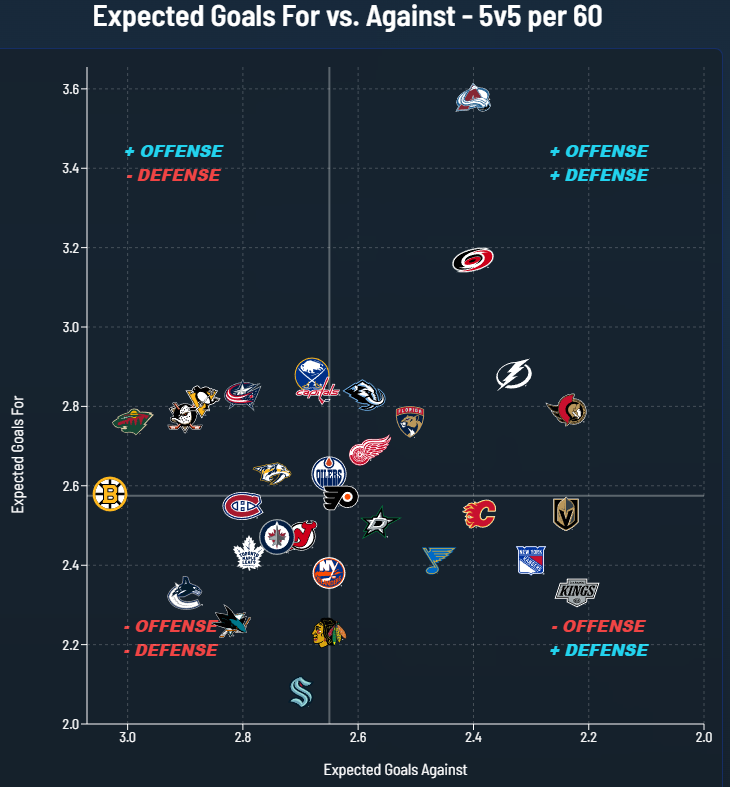
That isn’t to excuse a bad performance for a bad performance. Especially two in a row. But Dallas got shut down on the power play (and how). Given where we know they struggle, what other end result could there be?
The Stars are still in the thick of this. Yes, their shot share (of 45 percent) is bad. But their weak differential is coming entirely from an inability to generate chances per 60, where they rank last, versus their ability to suppress chances, where they rank 14th. What that does that say about where Dallas is headed in the new Murder Death kill division? I don’t know. Depends on your expectation based on the evidence rather than your expectation based on their record.

About those power plays
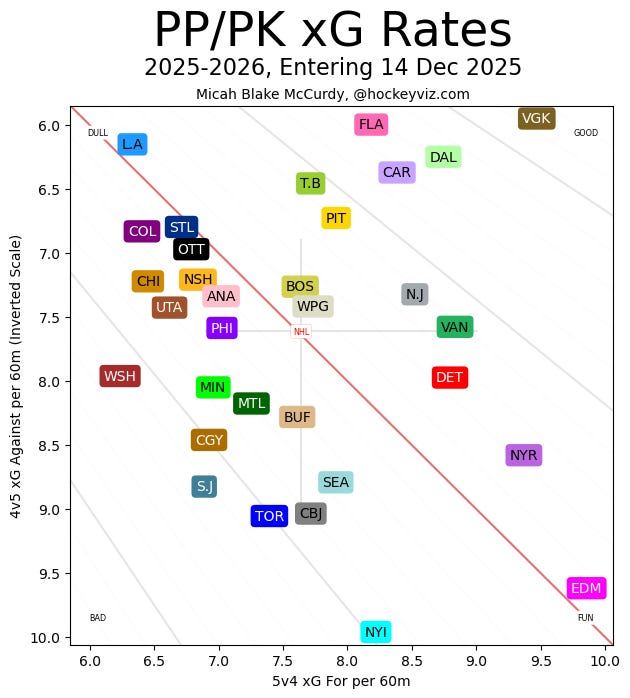
Dallas allows 16.18 shot attempts against on the man advantage. That number is adjusted for minutes. And that’s 28th in the league. When looking at expected goals allowed, it’s 30th. These are odd stats because these are not things we usually think about. Nor are they things that are important long term. I would happily argue that they are, in fact, not: give me an elite power play that is historically dangerous at the cost of allowing a few extra shorthanded chances any day of the week and twice on domingo.
Tales From The Clipped: How the Dallas Stars power play under Neil Graham has become the most lethal power play in the analytics era

As of this writing, the Dallas Stars still lead all 584 rosters in the analytics era in shot quality generated on the man advantage. That’s right. 11.67 expected goals per 60 leads all. I find that to be more impressive than their conversion rates because conversion can be subject to the ebbs and flows of the hot versus cold hand. Conversion can be goalied. However, consistency in shot quality speaks to your habits, your systems, and your tactics. If it’s there, chances are, it will
Obviously, you’d rather not see those chances against at all. But I do wonder if there’s some relationship between being extremely dangerous on the man advantage, and the proverbial other end of that sword. It’s not analysis, but Dallas, Pittsburgh, and Boston are all top five power plays…that are also bottom five in shorthanded chances allowed. This changes nothing about the fact that Dallas is an elite, special teams squad. Interestingly enough, this would appear to be a feature of most elite teams, with…some odd exceptions.
It was quite clear what Florida was trying to do: while the telecast made a meal out of Dallas “looking discombobulated” it was extremely evident that Florida made them look that way. The Panthers don’t look like an elite PK team because of their save percentage, but that’s on goaltending. Florida’s penalty killers are better at their job than their netminding (at least so far), and well — Dallas hasn’t seen a PK like that in some time. Chalk it up to a learning experience.
If Dallas’ special teams seem like they’re a bigger deal than usual, and that we’re actively talking about some of the shorthanded chances they gave up (something confined to freak occurrences), then it’s because of their EV play. Nothing more.
Quinn Hughes to Minnesota and how it affects Dallas
When I previewed the Minnesota Wild from the other place, I had them missing the playoffs by just a hair.
I have them missing the playoffs this year. When you look at teams that make the cut one year, and not the next, they look like the Wild: teams that are one injury, or one bizarre streak away from pieces written about them — how “things are disarray” and “management drama” and “unhappy players” etc when the fact is, these are always the teams that would be on the precipice anyway. Minnesota feels like that team. Having said that, there’s still a way out. If Buium turns on that switch, there’s no reason why Brodin, Buium, Sprugeon, and Faber aren’t your top four. That’s a damn good blueline. That and Kaprizov, with a brickwall in net? That’s a tough out for any team.
Zeev Buium, Marco Rossi, Liam Ohgren, and Minnesota’s 2026 1st turned into Quinn Hughes in one of the biggest trades since Rantanen and Tkachuk.
I’ve seen a lot of different reactions from Stars fans; mostly some degree of ‘meh; it helps but won’t be enough to beat Dallas or win the Central for that matter.’ It’s easy to see why, given the Wild’s ghastly center depth. They’re also a team ripe for regression, and not in the typical way, but in a very symmetrical way.
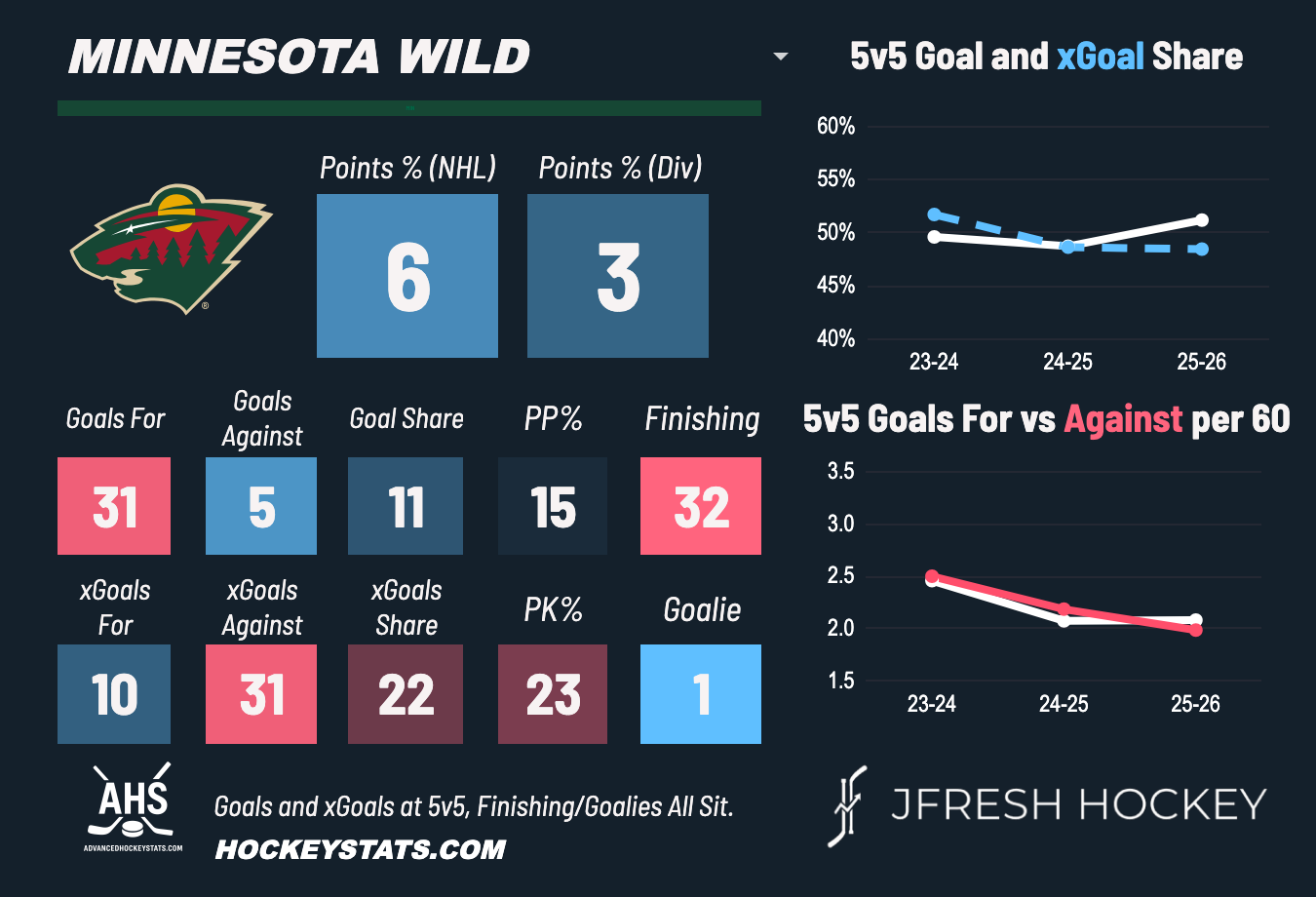
It’s hard to imagine their expected goals catching up to their actual goals without the expected goals against catching up to their actual goals allowed.
With all that said, it’s difficult to underestimate just what a difference adding a Norris-winning defender does to a team. Looking at Louis Boulet’s roster builder, the Wild go from a wildcard bubble team (93 points projected in the standings) to a playoff lock (107 points). When you consider some of the Wild’s weaknesses, especially on the breakout, Hughes’ elite ability to single handedly fix that will be a boon for them. It’s hard not to get the feeling that the Wild pulled off the defensive version of the Matthew Tkachuk trade. Sure, Buium is a stud (proving it Sunday night). But he was on Minnesota’s third pair with Zach Bogosion. Hughes bumping Jonas Brodin down, their version of Esa Lindell, says a lot their depth and how far it can take them. In many ways, Minnesota’s approach to their blue line at the cost of forward all stars reminds me of Florida’s approach to their forwards at the cost of defensive all stars. No I am not comparing the two (Panthers were much better before Tkachuk than Minnesota was before Hughes); simply comparing their strategies.
I had this discussion with a kind reader in the chat this weekend. There are rarely specific commonalities between Cup contenders, despite the copycat phenomenon. The only common thread is that great teams have diverse cores. However, there are different ways to build. Florida and Tampa went the bottom-up approach, maximizing potential with a high floor. While Colorado and Vegas took the top-down approach, maximizing potential with a high ceiling. It’s a spectrum, so we don’t have to debate the margins, but still.
Watching Hughes last night brought this point home. I don’t believe the Wild are a Cup favorite or anything close. But their roster is a lot closer with the addition of just one player. At least until they add something halfway resembling an NHL center besides Ek. In other words, Minnesota deserves to be taken seriously with the addition of Hughes, but they have a serious ways to go before being a team that can upset Dallas and Colorado (despite doing exactly that this month).
Previewing L.A.
As much as I find it hard to take the Kings seriously, there’s no denying that Hiller is channeling Bowness here. L.A. is a very good defensive team. Lucky for Dallas, they can get got on the penalty kill.
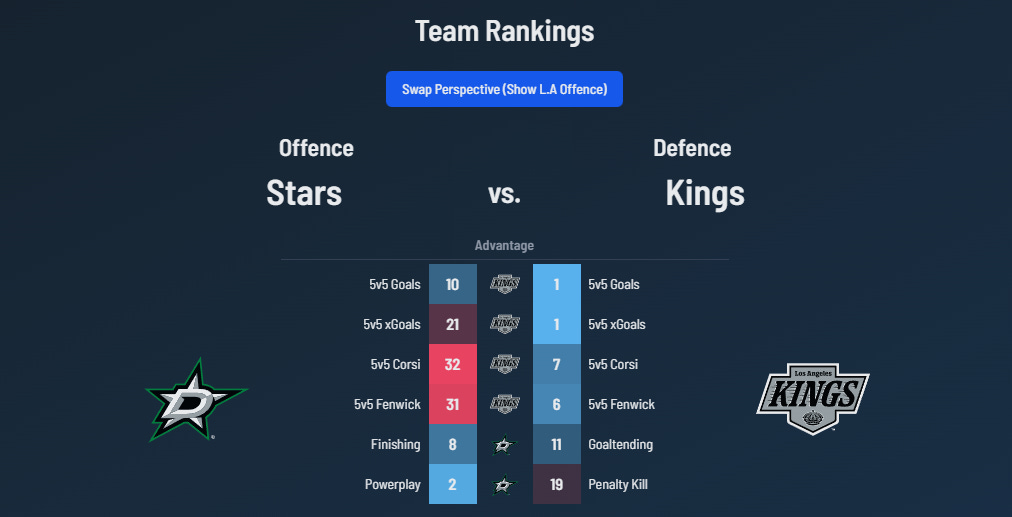
Expect it to be another big game for Jason Robertson, Mikko Rantanen, and especially Wyatt Johnston. This is probably a group itching to prove that getting busted in the chops by the Panthers on special teams will never happen again. However, one thing I’ll say in the Kings’ defense is that their penalty killing is actually on point despite their rank: they’re 7th in shot quality allowed, meaning only the netminding las behind. This will be an excellent test — Kings, like Florida and Dallas, love to pressure high from their diamond formation — for Dallas’ power play and ability to adjust.
In terms of LA’s offense versus Dallas’ defense, it’s a pretty lopsided matchup in the Stars favor.
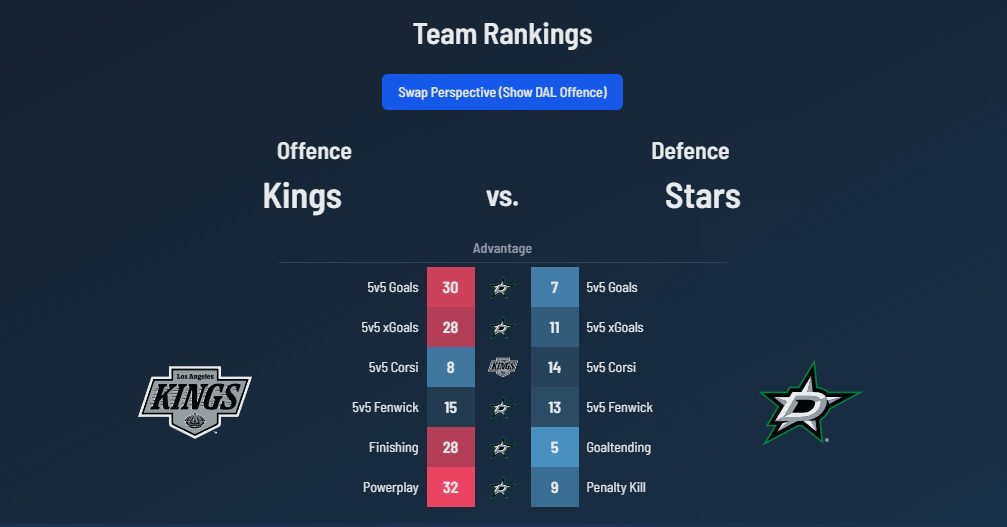
Kings don’t finish well while Dallas goaltends well. Their power play is the worst in the league, and they don’t even generate good shot quality at EV. Adrian Kempe’s 28 points would be fifth on Dallas; technically sixth if Hintz had been healthy.
However, points aren’t everything. Quinton Byfield is still pound for pound one of those talented players on earth, making it a low down dirty shame that LA hasn’t been able to get more out of him. This should be a low scoring affair with (wait for it….) the game decided on the back of special teams.
Programming note
I’ll have a recap up after the game. But Wednesday will be the day: film room analysis on why you’re wrong about Jason Robertson’s defense.
The Wild fans could have a sad awakening this summer when Hughes will probably refuse to extend in Minnesota. It’s kind of pretty clear that he wants to play with his brothers, and this summer will probably be their last chance to make this happen.
This trade could take Minnesota back to a very ordinary team since they wont get a magic return if dealing with only one team.
IMHO, you dont trade for players like Hughes without being damn sure he is going to play with you long term.
Nill got it right with Rantanen.
We have to find a way to bust the bubble on the good goaltenders. We are getting too many shots that are being blocked at 5 v 5. I don’t think mixing up the lines is the answer. I think we need another gunner. Seguin was on a 50 + point pace and minus the big four no other centers/forwards are. Even with Duchene back I don’t think he fills that void. We have Borque,Blackwell, Steele, Back, Faksa and Hryckowian that are essentially 20 point a year scorers. That is half of your starters. Throw in Benn and Duchene at 30 and the teams send out their best defenders against our 4 scorers and get what we got with Florida, a shutout.