
Stars Stuff: What Detroit's failures with Dylan Larkin have to do with Dallas, being happy for Stankoven, the summer schedule, and a re-introduction to this place
Have we met?

First and foremost, I want to thank you, the reader. It’s a privilege to be able to write about hockey and have a loyal readership. This project of mine has always aimed to be a conversation above all. I write to express my thoughts and struggle with whatever analysis of the game interests me, and you read to question those thoughts, and that analysis. If we come to an agreement, that’s fine. But agreement is not the point.
So if you’re a new subscriber, this is more or less what you can expect here. My inspiration for sports writing was Jordan Breen, a former colleague of mine (RIP). It was obscene how he could talk about the legends of MMA as thoroughly as he could he talk about prospects on the regional circuit, whether it was in North American, Japan, or just the parking lot of a seedy Atlanta strip club. Described once as a “living archive of the sport” I’ve always known that achieving that level of coverage is impossible. But the struggle towards it should not be.
And so you’ll read about Wyatt Johnston and Jason Robertson in the film room here. But you can also read about Stars prospects like Emil Hemming and Cameron Schmidt. Or further down, Aram Minnetian and Brandon Gorzysnki. If you’re interested in the minutiae of how Dallas’ power play worked so well, you’ll find it. If you’re curious what happened to the PK this year, I’ve got you covered. If you’re interested in why the defense that was so successful all year struggled in the postseason, likewise. None of this is to say that you’ll find answers. But you will experience a conversation.
You’ll also get a lot of charts and graphs. I’m a big proponent of trying to understand hockey on a macro level. No, a single player card posted on Twitter is not all the information you need to make judgments about player performance. But performances and patterns go hand in hand. If a player is truly excelling, whether on the boxscore or on the ice, you will see positive trends. If they are not, you will see negative trends. This is not a hard and fast rule, but reading between the lines offers its’ own insight; insight not into just what’s happening, but insight into what we can expect to happen. It’s not a coincidence that Florida and Carolina are two teams who invested heavily in analytics, with Eric Tulsky being the most visible1. As a result, I’ve done my level best to make the stats you see are understandable for casuals. In fact, every year I will update this casual fan’s guide, just as I did in 2024 and 2025. During slow season, I’ll write an introduction into Louis Boulet’s work because he’s doing genuinely cutting edge stuff; the kind of stuff that models and model makers have been criticized in the past for ignoring or minimizing.
And that about covers it. I don’t like walks on warm sandy beaches, but I do love sludge metal and sci-fi. I run a book club in the Discord, which is a lot of fun. And I’ve taken up bouldering, because Magnus Midtbø makes it look so cool even if the exercise itself is well beyond what my crippled body is capable of.
The Dylan Larkin saga
I feel kind of bad for Red Wings fans; especially casual Red Wings fans. In the face of playoff performers like Mitch Marner, Mark Stone, Jack Eichel, K’Andre Miller, and even Nikolaj Ehlers — you would think the message is clear: it’s easier to get the best out of your best players when they’re surrounded by better talent. After all, anyone remember the narrative around them when they were with their previous teams? Except for Miller and Ehlers, these players were seen as perennial losers. Steve Yzerman has not surrounded Larkin with better talent. He hasn’t even surrounded Larkin with good talent. Andrew Copp and J.T. Compher are the centers behind him on the depth chart. Lucas Raymond has been a fantastic draft pick and developed into an elite winger. But over the last three seasons, they’ve played with players like Emmitt Finnie, Marco Kasper, and David Perron; more of a goulash of chemistry rather than a signature dish. Larkin has neither his Cole Caufield, nor his Juraj Slafkovsky. And that’s not even counting the other problems with the Red Wings roster.
So what does this have to do with Dallas? Well there’s chatter. Official chatter, it should be noted. Let’s skip past this, though. As I posted on social media, this is a goofy idea for all the reasons you already know.
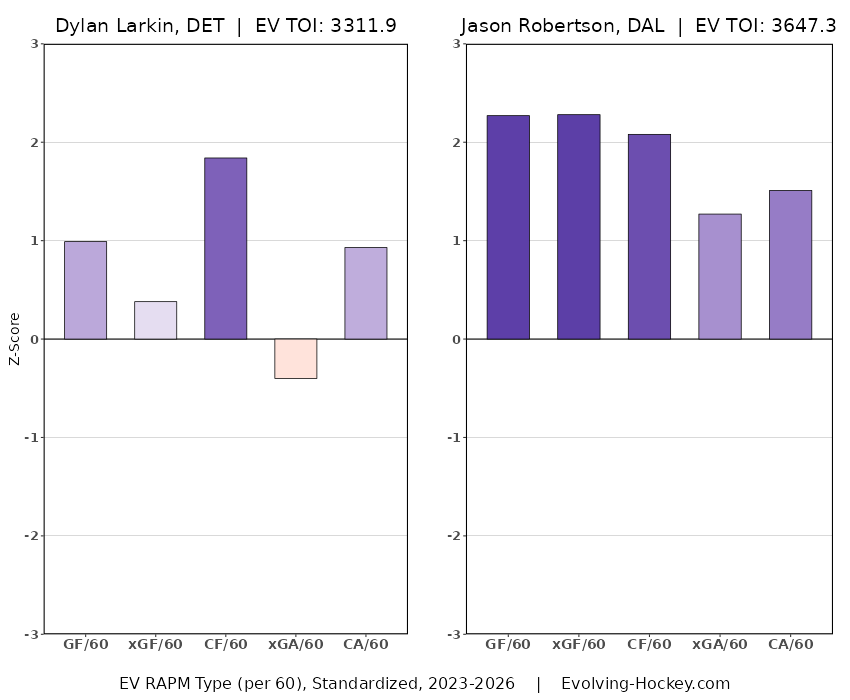
But this isn’t even about why it’s goofy just as a contrast between forwards. It’s not even about whether any GM would be foolish enough to trade a top 10 winger for a second line center. It’s about how little sense this makes for either team. Detroit downgrades to having no center depth in order to upgrade at wing while Dallas downgrades their winger depth in order to upgrade their already abundant center depth? Two teams losing a lateral trade would certainly be one thing; two teams losing a lateral trade on opposite ends of the competitive spectrum, no less, is entirely another.
If the case for trading Jason Robertson is a cap case, then any theoretical trade should involve Dallas making cap room. Adding another four million is not really cap room; it’s bonus money, not a roster player for a top four defender, or middle six left winger. This is what confounds me about Dallas doing their “diligence.” Making cap room would be targeting players like Anton Lundell, Kirill Marchenko or — if Dallas really wants a redundant center — Quinton Byfield, who is just $6.2M against the cap until 2030. That’s also, it should be noted, when Miro Heiskanen gets his next contract.
If I seem prickly, it’s not because I have a problem with rumors. It’s certainly not because I’m “above” what can be fun speculation. And it’s worth reiterating that we’re not even talking about a rumor at this point, as we have insider confirmation about Jim Nill making what we assume is a perfunctory inquiry. It’s really about bad ideas. Trading Robertson is not a bad idea in and of itself. Trading Robertson for Larkin is, however. Robertson has the edge in points (365-285), goals (155-129), and wins above replacement (12-7) since 20222.
Beyond that, while I have my own reservations about the Stars’ weaknesses and general forecast, the criticism about Dallas ‘running it back’ is one of the weaker arguments for trying to make cap room in order to make a deeper run next season. For two reasons 1) cap relief is coming the season after next and 2) the upward development of three key players who are already showing upward development.
What does the development path hold for the players still on it, like Mavrik Bourque, Lian Bichsel, and Nils Lundkvist?

The NHL may not be a development league, but players have to develop in order to get better. With or without the league’s cheesehead philosophy, development matters. How far does Vegas get without the upward progression of Brett Howden and Pavel Dorofeyev? Carolina without Logan Stankoven and Jackson Blake’s development? Sam Malinski. Ivan Demidov. Kaiden Guhle. It’s not always younger players either. Taylor Hall, Sean Walker, Ryan Hartman, Marcus Johansson, Darren Raddyish. Can’t be neutral on a moving train, and all that.
Congrats, Ovenmaster
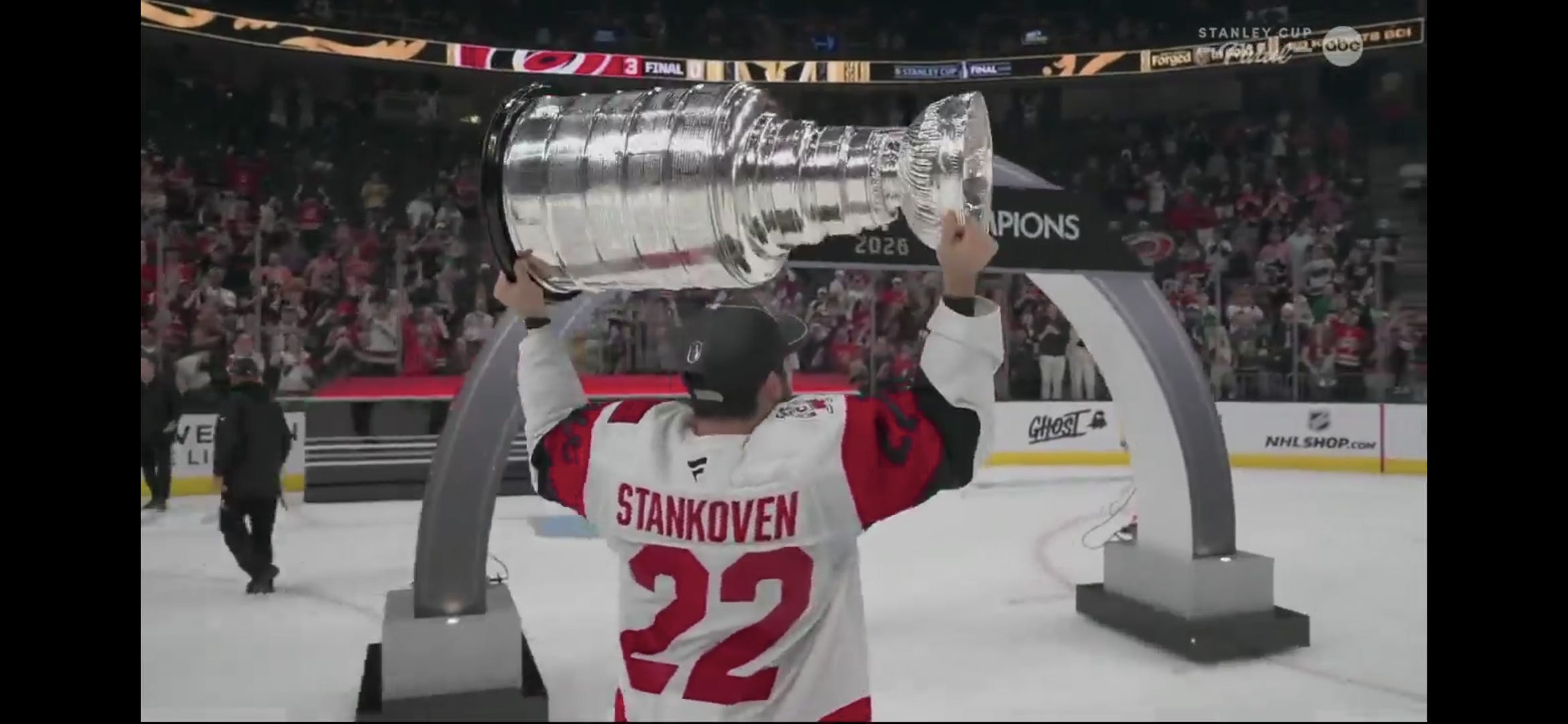
What a postseason for Logan Stankoven. 11 goals, and 16 points in 19 games. A 47th overall pick. 5’8, 165lbs. The endless forward played his natural position, and the Hurricanes were rewarded with the ultimate prize. In the coming days, we’ll probably read a lot of hindsight analysis about “who won the trade” but this neglects so much context; namely that Carolina leveraged the assets gained to form a new base for its’ core with the additions of Taylor Hall, Nikolaj Ehlers, and just as critically (because he was phenomenal for most of their run) — K’Andre Miller. Not many GMs have these moves in the bag. Even Tulsky didn’t, as they would have kept Mikko Rantanen if he had been willing to sign. He didn’t, and the rest is history. There’s room for discussing what could have been, but to me that discussion really only has legs if there’s smoke to Robertson’s future cap being an issue for the team long term. But that’s if. For now, let’s celebrate this magic moment for a player every Stars fan has always believed in.
Summer Schedule
Because this is draft month, I’m super pumped. While Dallas is not picking in the first round, there are always interesting players with potential, even if that potential tops out as an AHL regular. I’ve focused a lot on left wingers and right-shot defenders because that’s what I assume Dallas will be heavily scouting given their pipeline depth at both positions, which is to say minimal. That doesn’t mean that’s their guiding philosophy. In point of fact, we know that’s not it per their amateur scouts3.
Into the weeds with Dallas Stars amateur scout, Dennis Holland

Scouting fascinates me. As much for what I know (or think I know at least) as what I don’t; for what it finds, or does not; for how it works, and how it fails to work. Why does Scott Glennie, picked in the first round of the 2009 NHL Draft, end up playing only a single NHL game while Jamie Benn, picked in the fifth round of the 2007 NHL Draft, end up winning the Art Ross?
But without obvious BPAs late in the second and into the fourth rounds, the Stars will likely have a type. Today we looked at a look at Finnish scoring winger, Matias Vanhanen. Here’s a quick preview for the rest of the week.
June 15-19
Tuesday: Draft Profile(Timofei Runtso)
Wednesday: Draft Profile(Ryan Roobroeck)
Thursday: Draft Profile (Vladimir Dravecky)
Friday: Draft Profile (Filip Novak)
The Runtso and Roobroeck profiles will be for paid subscribers. The week after, the first two profiles will be paid as well.
June 22-26
Monday: Draft Profile(Oscar Holmertz)
Tuesday: Draft Profile(Axel Elofsson)
Wednesday: Five honorable draft mentions (forwards)
Thursday: Five honorable draft mentions (defensemen)
Friday: A casual fan’s guide to the 2026 NHL Draft
I’ll have draft grades the following week, and then broad coverage for the free agency period that follows. After that July and August will be filled with report cards for each Star for the 2025-2026 season, including Stars personnel.
Thanks for being here, dear reader, and I wish you good fortune, however trivial.
This is true of most recent winners. Michael Peterson’s work in Tampa Bay was given its’ own story, and we all know about Colorado.
As for the position argument, Dallas doesn’t need more faceoff wins. They need more offensive zone shifts.
I’ll try to target another amateur scout interview this summer, but I need to figure out a different angle before doing so.
That is one of my takeaways from this SCF: don’t trade good players away 😂 but then again, maybe I’m just looking for justification for my anti-“trade Harley” stance, which was bolstered every time the broadcast mentioned K’Andre Miller.
Very happy for Stank, and for Andersen especially. As many have said, that Canes team is a very likable one, especially compared to their counterparts and recent predecessors.
David, I’ve very much appreciated your articles. Keep em coming! Even if the analytics get too deep for my old school eyeball/brain.
One Stars point (I read somewhere) that’s bugged me… that Rant likes a R handed center… from my perspective… Rant playing r wing as a left shot gives him unique angles of attack that can throw off defenders, besides him literally throwing them off! But, I didn’t see any special chemistry with Wyatt. A traditionalist would say Rant would gain from having a left shot center, as passing on forehand is normally better…Is Hintz that center? Hintz plays such a speed game and his center play is great defensively… but is he the best set up guy for Rant, or the best to be set up by Rant???
To me the priorities are:
-sign Robo
-find teammates that maximize Rant, while we’ve got him! That’d be… hell if I know :)))