
Stars Stuff: Revisiting the concept of 'checking', team talking points leading up to Jim Nill's press conference today, the summer of slop, and the schedule ahead
A mea culpa, slop talk, and the Stars Stack schedule.

Yesterday I wrote about Glen Gulutzan’s press conference. It was a blow-by-blow of why the data was unequivocal with regard to Dallas as a forechecking team: because they’re not. Not in the regular season, nor were they in the playoffs. It might seem like puck minutiae, but I think it partially helps in explaining why Dallas’ historically low shooting percentage — which ranked #304 out of 312 playoff rosters since 2007 — didn’t happen by accident, even if they deserved better. Like the goofy dog on a bone I am, I heard it, I saw it, and I snapped.
‘Snapped’ is unfair in my biased opinion. I think I took a pretty nuanced view, all things considered. Strong wording, perhaps, but hardly sharp or biting and certainly not insulting. Nonetheless, after some quality feedback from those I respect, perhaps I was wrong. Checking and forechecking are not mutually inclusive. Checking is not a strictly offensive phenomenon, after all. And that’s a fair point. Because of that, I changed the title of that article.
However, I still stand by that analysis in the broad strokes. I want to be clear about something first: without hearing from Gulutzan himself and his definition of checking, this point is moot. At minimum, we can grant that Gulutzan’s hockey education involves having forgotten more than all of us in the peanut gallery (myself especially) will ever know. And hopefully that can include a discussion with Gulutzan himself at some point.
For now, I just want to clarify where I was coming from. I’ve always assumed checking to be an offense-adjacent term; it’s not synonymous with ‘forechecking’ but it’s certainly an aspect of it. It’s a term Ken Hitchcock would use in terms of what he thought underlined the creation of scoring chances, and how checking is that bridge between offense and defense, and how one links with the other. John Tortorella has used ‘checking’ in the same context. But it’s also clearly a defense-adjacent term too.
However, if we were talking defense too — and splitting hairs — would that have been true on the other side of the puck? Dallas did keep scoring chances down (they were 6th in chanced allowed in the homeplate area of the ice per 60 according to Natural Stat Trick), but they also routinely left the neutral zone wide open (for perspective, not even Vancouver’s blue line had a single defender that could be qualified as aggressively ineffective, and conservatively ineffective).
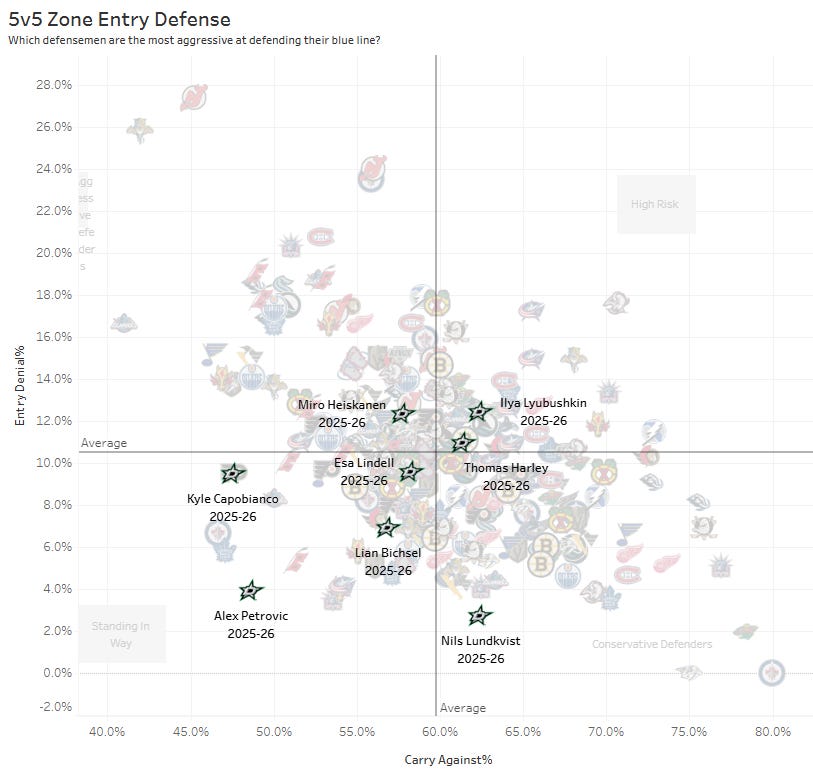
The end result was a team that allowed rush chances at a bottom 10 rate. This was all in the regular season, mind you. This makes the postseason end result somewhat unsurprising at least from a neutral zone perspective. It’s not a mistake that Dallas ended up being so top heavy as to be outright shallow. Nor is the concept of the data not matching the results that unheard of, as we saw with Ottawa this year: another dump-in heavy team who didn’t create off the forecheck and who couldn’t stop the rush.
I’m not saying that Dallas’ defense was ‘bad actually.’ Even the tracking data above can be rationalized as intentional. If the team is conceding the neutral zone in order to collapse down low, then of course the numbers will look bad. However, doesn’t this change the entire meaning of what we’re (well, just me really) talking about? In what way is Dallas aggressive…in any capacity? Everything about Gulutzan’s system reads like a hyper-conservative approach.
Into the weeds: Understanding the Dallas Stars, their systems, tactics, and how well the players are following them under Glen Gulutzan with Jack Han

It’s not what a system is about. It’s how it’s about it.
All of this might seem like overanalysis. Perhaps one or both feet were and are in my mouth on this one. There could have been better ways to articulate my nitpicks. Nonetheless, to me this feels like it warrants inspection. In the same way the early-season talking point about increased physicality never materialized, could the same be true of Dallas’ checking philosophy? Or is this an execution problem? At one point are both tied to one another?
While all of this has me growing skeptical of the system, that system is still unfolding. Just as DeBoer’s system gradually opened up for more offense, so too might Gulutzan’s. Perhaps so too will the clarity on what exactly Dallas is trying to achieve, systems wise. If it does, I promise I’ll be the first to write about it. If it doesn’t, I’ll be a little less quick on the trigger.
What do you want to hear from Jim Nill?
I suspect a lot of fans will be itching to hear what Nill has to say when he holds his press conference at 10AM today. He’s got a ton on his docket. There are big issues, like extending Jason Robertson. There are small issues with big consequences, like whether to bring Jamie Benn back — a player he has stated, on the record, as wanting to keep as long as he’s GM. Everything in between feels like high stakes too: clearing out cap by potentially trading Ilya Lybushkin, Sam Steel, Radek Faksa, et cetera. What does Mavrik Bourque’s deal look like? Will Dallas be in the market for a right-shot defender? Will they be in the market for a left-winger that can play next to Wyatt Johnston and Mikko Rantanen? Can they entertain a presence in the market in the first place?
And so we’re really left with just two questions: will he break up the core in an effort to make it better (quite the paradox I know), or will next season be all about keeping the core intact and seeing what the Stars can do when healthy? The former is not in Nill’s wheelhouse, which makes the latter the smart money. When I went on D Magazine’s show earlier this year, this was the heart of my argument; that this season wouldn’t be it and that Dallas shouldn’t treat it that way. In fact, if I had been quicker on the draw, I would have finished the piece that I starting working on March 4.
Do I feel the same way? Mostly. But we’ll get to that later. For now, get ready for the summer of slop. You’re going to hear the worst Jason Robertson rumors because Robertson rumors are always the worst anyway. Maybe you will read “whispers” about Thomas Harley. Maybe Dallas is in the running for Connor McDavid. Or Auston Matthews. I can’t control your reading habits, but that doesn’t mean I can’t write at you like a disappointed parent: stay away from the slop. Don’t waste time reading or watching content that others didn’t take time to thoughtfully create. That’s my fatherly advice for the day. Don’t let the anxiety economy get you caught up in the game. Save those anxieties for sincere places.
Anyway: Nill is not the type to let things slip, and there’s no reason to expect Nill to do something as uncharacteristic as trade a full-fledged star. That’s not to say something dramatic won’t or can’t happen. I’m sure there are ton of disappointed people in upper management who saw three playoff rounds go down to just one. Perhaps it’s uncharted territory and something cracks. However, Dallas’ core is already an elite one. Their window is wide open. Paul Pidutti wrote a statistical recap comparing current teams to former champs, arguing that based on the data and player comps, the Stars’ current window sits in the highest tier of contenders and doesn’t statistically close until 2029 given their core’s age.
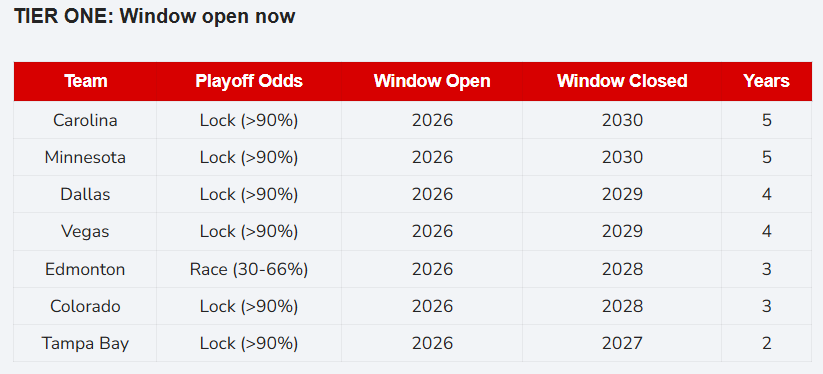
While this is a little reductive, the point remains: when healthy, the Stars have an elite core, and will likely be better served by trying to preserve it, and pinpoint 2027-2028 when Tyler Seguin’s contract comes off to go all-in — rather than say, trade all their underperformers just because an injured team couldn’t beat a strong Minnesota squad. There’s a reasonable discussion about what Dallas should do that includes the optics of the dramatic. There just isn’t a lazy one.
The road ahead (here at base camp)
Guess what? Stars Stack just crossed 2,000 subscribers. [Insert party poppers and silly noises] And that’s awesome. It’s articles like yesterday and today where I have to admit to questionable judgment that makes me wonder how I ended up with that many subscribers to begin with. Regardless, you’re all fantastic for sticking with me, and I love each and every one of you. We’re gonna have to start figuring out get-togethers for the summer, even if most of you live in Dallas instead of Forth Worth. In the meantime, join the Discord!
I have a few projects in the works for how to level up this place, but until I have something concrete, there’s no use talking about that. For now, there will be some more doom and gloom ahead (looking at Dallas’ defensive performance versus Minnesota), but we’ll also look at some positives, like film room on Mavrik Bourque, and what a revelation he became not just late in the regular season, but in the postseason; something that sadly got lost in the frustration of the first round loss. We’ll be doing fun comps, like looking at the remaining matchups and seeing what Dallas could learn from Montreal, Buffalo, or Carolina, etc. And I’ll also be writing about Emil Hemming, who is in the OHL Finals — by far Dallas’ most advanced prospect, and someone who might offer an NHL cameo sooner than expected.
Some of this will be paid (I haven’t finished my paid post spreadsheet, but I will soon, which you can access it here). Some of these will not be. Regardless, I can’t thank you enough. And I don’t take it for granted.
FWIW you were spot on in your analysis of the lack of forechecking. Gulutzan and Co. need to look hard at their defensive scheme and whether it's actually the cause of the offensive issues, or at least contributing. "Hyper-conservative" is exactly how this team played this year. Even their slow starts, I'd chalk up more to trying too hard to avoid the Big Mistake early in the game that lack of preparedness. Let the forwards work down low instead of risking a bad pinch. Give up the defensive blue line instead of risking getting burned.
And since I'm full of theories, I suspect the passive/collapse defense was a big contributor to Harley's struggles this year. I feel like he struggles at in-zone reads/coverage and gets stuck in opponents' cycles. He's better when he can be aggressive at the blue line and stop opposing offense before they can get set up and he's got the skating ability to execute. It's tough to design a system that maximizes all your players (especially when the roster construction is so bifurcated), but I can't help feeling like raising the floor for the bottom of the roster lowered the ceiling for the top this year.
I am already getting triggered by the Robo slop. So many opinions following the narrative that he is not physical enough or all he does is score. Some analysis has no depth. To me if the number is close to $12M a year or a little more, you have to sign him and figure it out cap wise.