
How Does It Affect The Stars? Looking at the Central, and how Dallas' matchup with Minnesota tonight can shift the division's landscape
Let's talk about the division.

When I previewed the Central Division before the season, it was clear that anything could happen. There were simply too many x-factors. And now it seems like the x-factors have multiplied. The new year hasn’t even begun, and Colorado has already fixed their goaltending, while Nashville is giving their scouts overtime to see if Matthew Schaefer is the real deal, and packed their golf bags1. Meanwhile, it’s difficult to know which of the Central’s most consistent teams have a gear above or below where they are currently are.
The Stars certainly look like they’re on the precipice. With 40 points thus far, they’re in the second wildcard spot. Two teams below them are within two points of reaching the same point total — Calgary and Utah — and Tyler Seguin is out for the season. Could the Stars really be in trouble, especially of they lose tonight’s contest with the Wild?
No. In fact, let’s do some non-dufus rankings. Dallas might be in the second wild card spot, but if we arranged the Central division by points percentage, the Stars would rank third, switching places with Colorado. If we ranked the Central Division by goal differential, Dallas would rank second (at +20), knocking down the Wild and the Avalanche. If we ranked the Central Division by expected goal differential at even strength, the Stars would rank first.
Now, the doomers might take issue with this math. Perhaps even the believers will take issue with this math, arguing that I’m being selective, and biased. And I am by no means trying to single out the doomers, who should not be ostracized to begin with. But in the last 10 years, only 12 teams have made the playoffs with a negative goal differential. A team like the Flames (-11) may look somewhat dangerous to the Stars, being just one point behind them. But historically, they have a seven percent chance of making the cut when all is said and done.
If anything, the Stars are more likely to catch one of the Central’s top three teams. But who? It’s hard to say. The Jets had a tough November, going 3-5 in their last eight. They bounced back in December, although they lost to teams like Anaheim and Columbus. However, Winnipeg’s current pattern is in keeping with previous seasons; not exactly a good omen. Minnesota is currently 4-6 in their last ten, dealing with injuries, recently struggled to put away the lowly Blackhawks, and bizarrely range between mediocre and terrible on special teams depending in which side you’re looking at. Colorado, oddly enough, would seem the most stable presence. However, it’s only because Nathan MacKinnon and Cale Makar are so good. Not because MacKenzie Blackwood and Scott Wedgewood are the new Swayman/Ullmark legion of netdoom2.
None of this clarifies Dallas’ place in the pecking order, per se. The Stars have their own arctic demons. The top line still needs to play Catch Up. It’s difficult to unpack the struggles of Wyatt Johnston and Logan Stankoven. The blueline is somewhere between flux and funk (defensively, the Stars are becoming quite porous, ranking 18th in expected goals against per 60). And then there’s the whole power play problem. But the guts are there to unseat one of Winnipeg, Minnesota, or Colorado IMO. Especially with the LTIR money they’re gonna use.
Dallas vs. Minnesota
As mentioned, the Wild are in something of a funk. Losing two crucial pieces of the top six (forwards) and top four (blueline) haven’t helped with injuries to Joel Eriksson Ek and Jacob Middleton. As you can see, despite being one of the most stable Central teams in terms of shot quality, they’re at their performative worst.
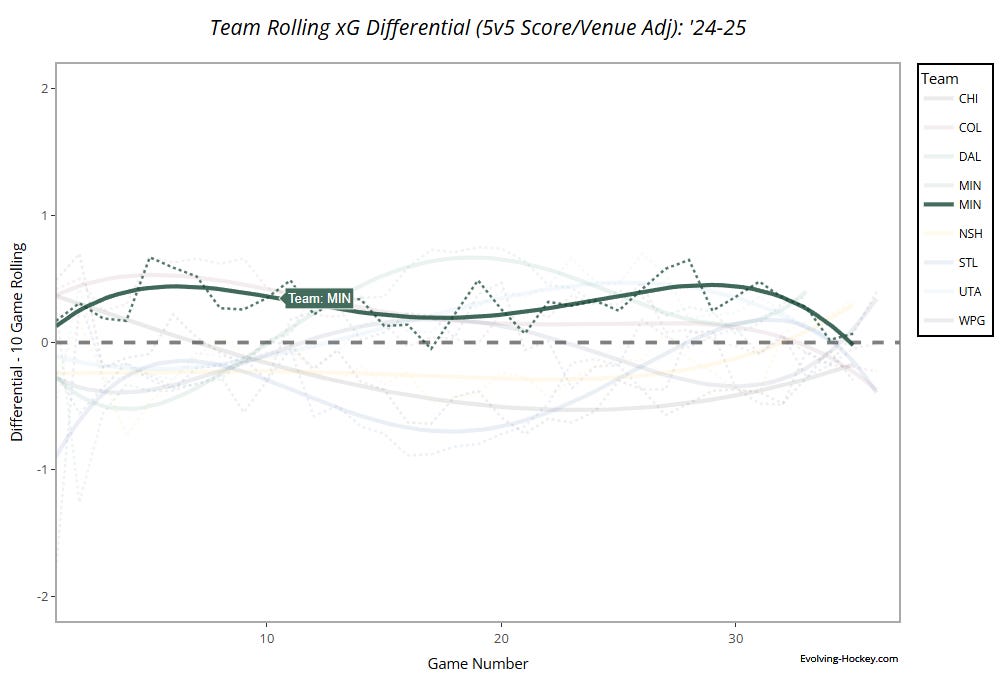
However, led by Brock Faber and Kirill Kaprizov, currently with 50 points, they make them a formidable opponent regardless of whatever slump they’re in.
With all that said, it’s been a good matchup for Dallas over the years. It helps that the Stars play a similar style with way more weaponry. Both play disciplined systems, anchored by star defensive defensemen, but Dallas has more lines to threaten with while Minnesota just has Kaprizov. Matt Boldy is an elite forward, but right now he’s on a line with Marcus Johansson and Frederick Gaudreau; kind of hard for him to ‘get going’ when he’s having to do push ups with a barcalounger on his back.
If ever there were a time for the power play to start clicking, it’s tonight. The Wild are 30th on the penalty kill. For whatever reason, their strong defense isn’t present on the PK, where they don’t suppress shot quality and their goaltenders aren’t bailing them out. Versus Utah, I was struck by the lack of change in the man advantage lineups. I know it’s just a tangible detail, but the numbers for Jamie Benn and Miro Heiskanen are truly weak enough on the PP that I think their absence could help. It’s by no means their biggest problem, nor am I educated enough to pretend like it’s an answer, but it’s at least worth a try. To Dallas’ credit, they’re looking better even if they’re not scoring. The movement looked downright great on the second PP oppurtinity versus Utah, and in the month of December, the Stars are 3rd in expected goals (adjusted for minutes).
I hate repeating myself, and these criticisms don’t add anything new to the conversation, but as long as they’re not scoring, the power play will continue to dominate the discussion. However, there are positives out of that, like Mavrik Bourque’s recent run on the top line, and Heiskanen’s shift-to-shift dominance. Yes, we quibble and argue over his offense — all valid — but his overall control of the game, especially defensively, is on another level.
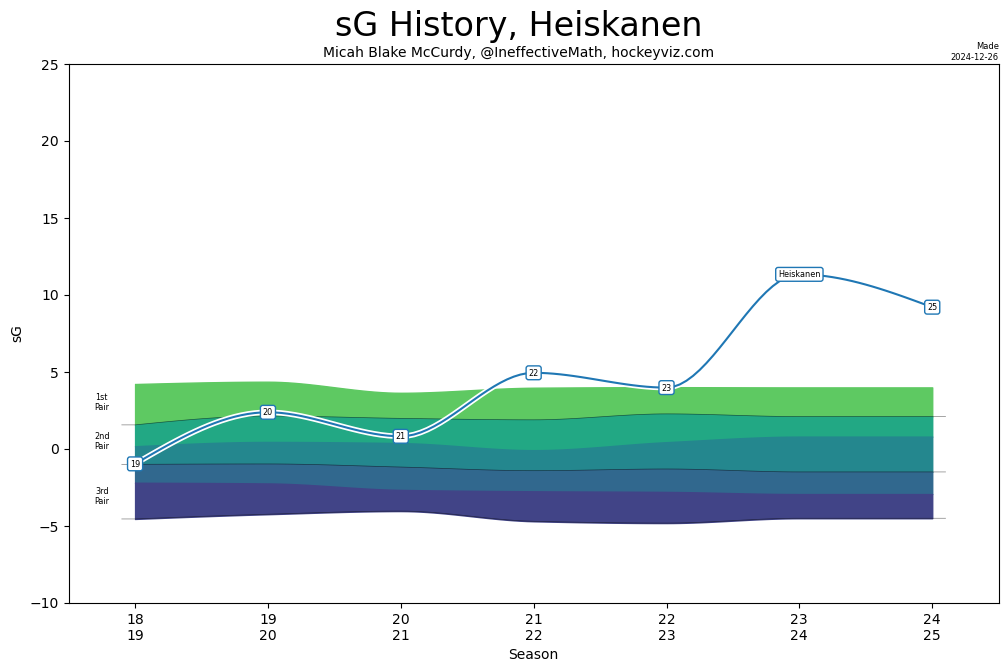
He is. I feel like we have to go all the way back to 2020 with Jake Sanderson to find a defensemen who didn’t have x-factors or questions about their overall game.
Blackwood certainly looks the part but I don’t believe he is. His save percentage is good, but the fancier stats — like delta Fenwick save percentage and Goals Saved Above Expected — are far less kind.
The statistician view would suggest the Stars are due for an unholy tear of dominance for a 2 month period as they revert to the expected mean. The philosophical view could argue that one can't account for the gestalt of human variables.
I prefer statistics.
It doesn't mean I'm not worried though. As you said in your article, I believe the Stars can have a good PP, but the fact that Spott has made no tangible changes for effectively the entire season is infuriating.
Apparently Kaprizov is out with injury tonight?